
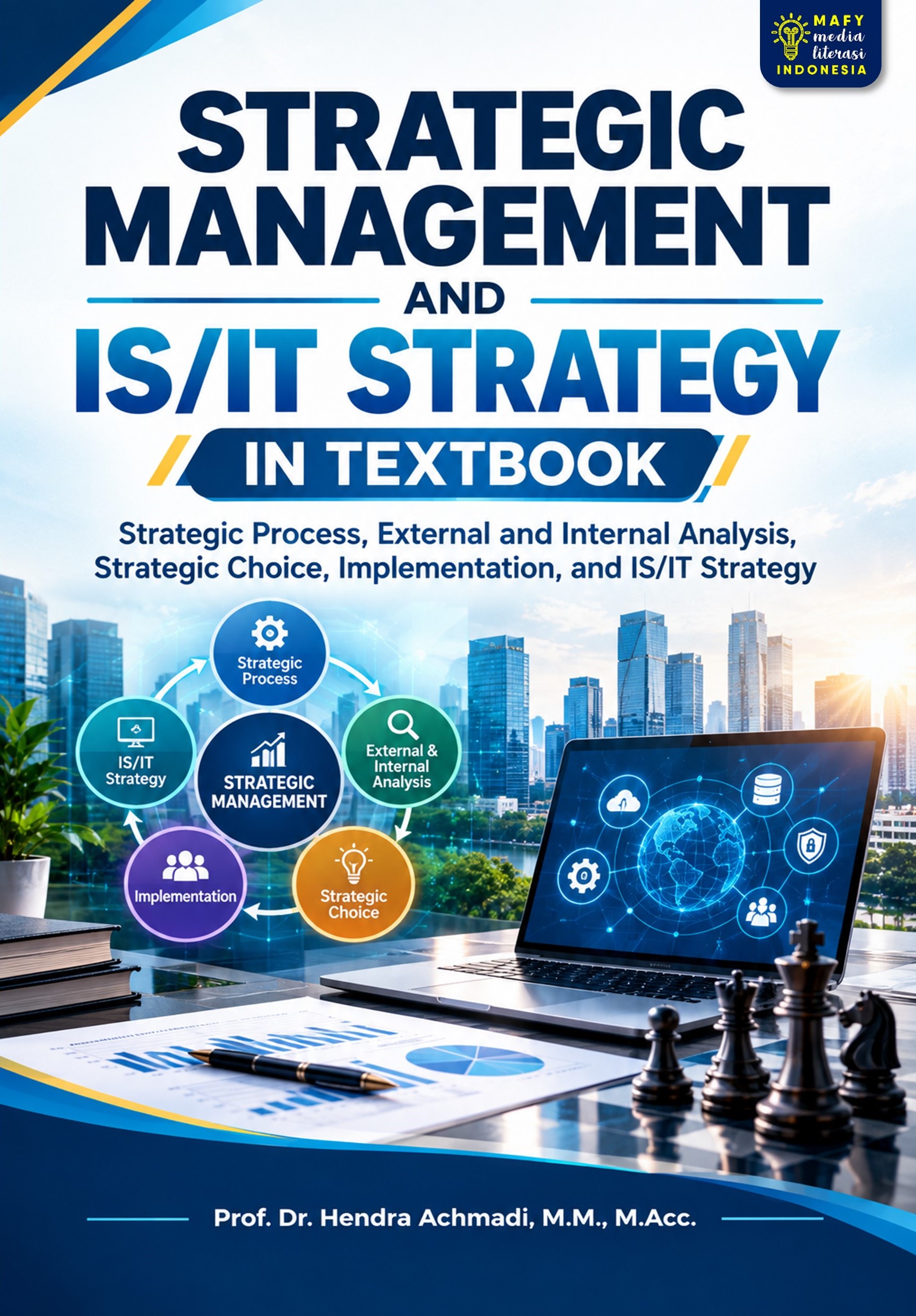
STRATEGIC MANAGEMENT AND IS/IT STRATEGY IN TEXTBOOK Strategic Process, External and Internal Analysis, Strategic Choice, Implementation, and IS/IT Strategy
Judul: STRATEGIC MANAGEMENT AND IS/IT STRATEGY IN TEXTBOOK Strategic Process, External and Internal Analysis, Strategic Choice, Implementation, and IS/IT Strategy
Author:
Prof. Dr. Hendra Achmadi, M.M., M.Acc.
ISBN: 978-634-308-623-9
First Printing: September 2026
Rp80.000
Order via WhatsAppStrategy has never been only about writing plans. It is about seeing an organization’s situation clearly, choosing a coherent direction, committing resources, and learning quickly enough to stay relevant. In the digital economy, this discipline has become more demanding. Customer expectations change faster than annual budgets, information systems create commitments that last for years, and data and artificial intelligence now shape how firms compete, operate, and create value. This book was written to help students, lecturers, and practitioners connect classical strategic management with the realities of information systems and information technology (IS/IT) strategy and digital transformation.
The book is organized as a continuous journey from strategic thinking to digital execution. Chapter 1 introduces the strategic process as a cycle of analysis, choice, implementation, and control, and explains why strategies often fail in practice. Chapter 2 positions IS/IT as a strategic resource, discussing the success factors of strategic IS/IT, the diffusion and infusion of technology, the IS/IT strategy process, and the alignment between business and technology.
Chapters 3 and 4 equip readers with the core analytical tools. Chapter 3 examines the external environment through the PESTEL framework, economic and technological signals, and Porter’s Five Forces. Chapter 4 turns inward to the value chain, the resource-based view, VRIO, the company diamond, the Balanced Scorecard, and the Triple Bottom Line. Chapter 5 then shows how analysis becomes decision: generating strategic options, screening them, making strategic choices under risk and organizational politics, and keeping strategy on track through strategic control. Chapter 6 completes the classical cycle by explaining how strategy is translated into action through leadership, structure, culture, stakeholder management, governance, and execution rhythm.
The second half of the book focuses on digital transformation. Chapter 7 explains why digitalization is no longer optional and how organizations can assess their digital readiness and the cost of inaction. Chapter 8 introduces the Digital Transformation Canvas as a strategic compass, and Chapter 9 applies the canvas to Indonesian industries, including digital banking and a smart palm oil estate. Chapter 10 describes the six stages of digital transformation together with a practical 90-day roadmap, while Chapter 11 presents a digital strategy implementation architecture that links strategy, initiatives, capabilities, and execution.
Two integrative cases illustrate these ideas in action. Chapter 12 analyzes AccorHotels as a global hotel group reshaping its customer journey, online content, e-reputation, and social media listening capability. Chapter 13 shows how shopping malls can move from intuition to intelligence through analytics, data mining, shopper journey mapping, precision marketing, and omni-channel integration.
The final three chapters extend the book toward the latest research and practice. Chapter 14 develops adaptive strategic planning in the digital economy, covering planning horizons, assumption registers, scenarios, option scoring, investment economics, dynamic capabilities, and the responsible use of artificial intelligence in planning. Chapter 15 discusses digital transformation strategy and business models, from customer value, customer journeys, and unit economics to platforms, ecosystems, data, AI readiness, technology architecture, operating models, and sustainability. Chapter 16 closes the book with the governance and performance of digital transformation, including portfolio governance, benefits realization, balanced performance systems, data and AI oversight, cybersecurity and resilience, and the decision to scale, revise, or retire digital initiatives.
Chapter 17 concludes the book with an integrative capstone. Using the fictional case of an Indonesian pharmaceutical distributor, it brings all of the preceding frameworks together in twelve steps, from defining the strategic question through external and internal analysis, option evaluation, the Digital Transformation Canvas, and implementation, to governance, performance measurement, and risk management, and it provides guidelines for readers to prepare their own capstone strategy project.

Ulasan
Belum ada ulasan.